
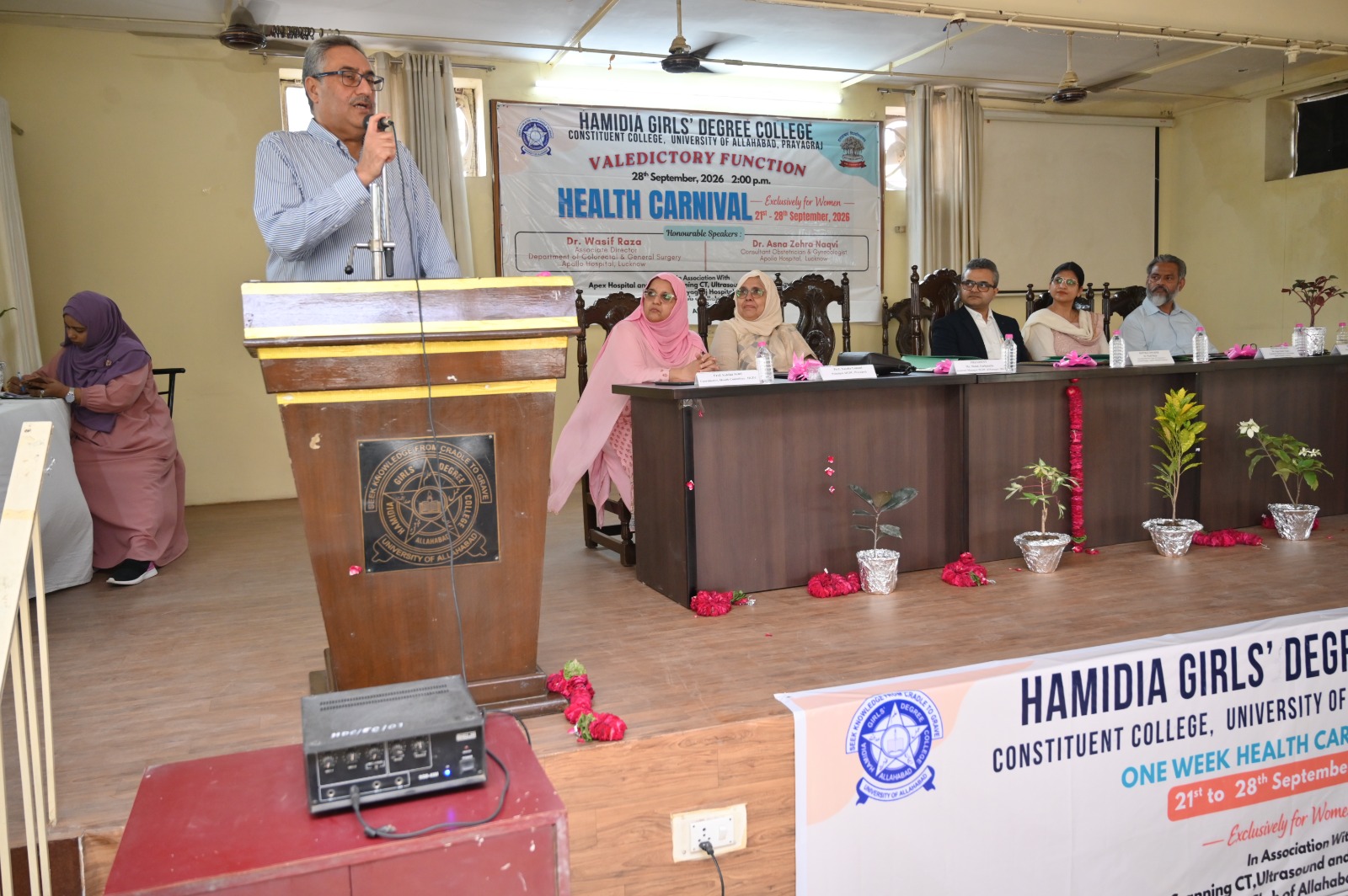
Prayagraj: The closing ceremony of the week-long ( 21st to 28th September 2026 )Health Carnival, organized under the NSS-Mission Shakti 5.0, at Hamidia Girls Degree College, a constituent minority college of Allahabad University, was held on Monday at Begum Khurshid Khawaja Hall. The program began with a Hamd recitation by Nida Fatima, a third-year BA student. College Principal Prof. Naseha Usmani delivered the welcome address.
Prof. Sabiha Azmi, Coordinator, Health Committee, presented a detailed report on the week-long Health Carnival. She detailed the activities and achievements of the health awareness programs, expert lectures, and free health check-up camps organized during the Carnival.
At the closing ceremony, keynote speaker Dr. Wasif Raza, Associate Director, Department of Colorectal and General Surgery, Apollo Hospital, Lucknow, shared important health information related to colorectal diseases and surgery. He said that Colorectal surgery is a field of medicine that deals with disorders of the rectum, anus, and colon. The field, also known as proctology, has many surgical procedures that treat various medical conditions affecting the lower digestive tract. Colorectal cancer is the third most common cancer worldwide, accounting for approximately 10% of all cancer cases.It is the second leading cause of cancer-related deaths worldwide.It predominantly affects individuals aged 50 and above, though there is a rising burden among adults 30–50 years old in some settings. Several lifestyle factors contribute to the development of colorectal cancer such as a high intake of processed meats and low intake of fruits and vegetables, a sedentary lifestyle, obesity, smoking, and alcohol consumption.
The incidence and impact of colorectal cancer can be significantly reduced by adopting a healthy lifestyle, avoiding risk factors, and monitoring symptoms to enable timely diagnosis and treatment. Factors that increase the risk of colorectal cancer include: lifestyle factors: diets high in processed and red meat and low in fruits and vegetables, physical inactivity, overweight and obesity, tobacco use and alcohol consumption; family history and genetics: a family history of colorectal cancer or inherited conditions such as Lynch syndrome or familial adenomatous polyposis (FAP); personal history: previous colorectal cancer or certain types of polyps; and age: risk increases markedly after age 50 though can occur at a younger age. Colorectal cancer often has no or mild symptoms in the early stages. When symptoms occur, they may include: changes in bowel habits such as diarrhoea, constipation, or narrowing of the stool; blood in the stool (bright red or dark and tar-like); abdominal cramps, pain or bloating that won’t go away; unexplained weight loss that is sudden and losing weight without trying; persistent fatigue; and iron deficiency anaemia due to chronic bleeding.
People who suspect they may have colorectal cancer should speak to their health-care provider right away.
He further suggested Prevention methods and said that Colorectal cancer can be prevented through a healthy lifestyle and early detection. Key prevention measures include:-eating a healthy diet rich in fruits and vegetables; not using tobacco; keeping an active lifestyle;
maintaining a healthy body weight; limiting alcohol consumption; avoiding exposure to environmental risk factors . He explained various screening methods of investigation.
Following this, keynote speaker Dr. Asna Zahra Naqvi, Consultant Obstetrician and Gynecologist, Apollo Hospital, Lucknow, raised awareness among the students on important topics related to women’s health. While addressing the audience, she said that Health awareness campaigns hold tremendous potential in providing educational value to target audiences. By raising public awareness about important health issues, it can reduce ill health and premature deaths from treatable diseases if addressed in time. Healthcare awareness campaigns’ importance lies in empowering people to take accountability for their health. She discussed about Cervical cancer. She explained that cancer starts in the cells of the cervix. The cervix is the lower, narrow end of the uterus (womb). The cervix connects the uterus to the vagina (birth canal). Cervical cancer usually develops slowly over time. Before cancer appears in the cervix, the cells of the cervix go through changes known as dysplasia, in which abnormal cells begin to appear in the cervical tissue. Over time, if not destroyed or removed, the abnormal cells may become cancer cells and start to grow and spread more deeply into the cervix and to surrounding areas. Many cervical cancer symptoms are also seen with other, less serious conditions. These are the warning signs you shouldn’t ignore.Long-lasting HPV infection causes almost all cervical cancers. She insisted that if you have a cervix, screening for cervical cancer is an important part of routine health care. Learn when to get screened and what to expect during and after screening.
Mohammad Farhanullah, Manager, MIC and Assistant Manager, Hamidia Girls Degree College, delivered the presidential address. He described the Health Carnival as an important initiative to increase health awareness among students and the community. He motivated students to excel in their field and contribute to the progress of the nation.
Dr Aariz Qadri ,director Prayagraj hospital, Prayagraj congratulated the entire team for organizing the health carnival. He said that the aim of this carnival is not only to create awareness but prepare us mentally to tackle our health and lifestyle related problems.This health carnival ensures that individuals understand the importance of maintaining a balanced lifestyle, managing stress, and seeking medical advice when symptoms arise.
The vote of thanks was proposed by Prof. Sabiha Azmi, Coordinator, Health Committee. The program was conducted by Dr. Siddiqa Jabir, Department of Arabic, Hamidia Girls Degree College. The program concluded with the national anthem.


