
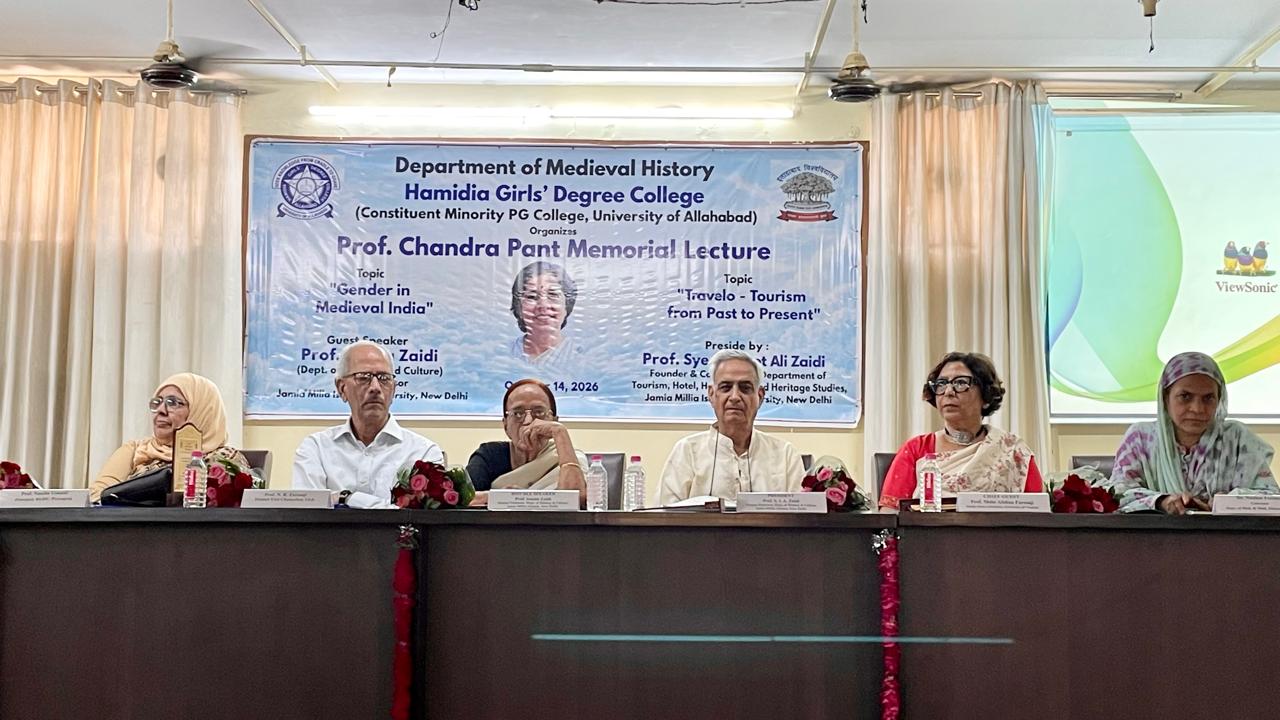
Prayagraj: Hamidia Girls Degree College, University of Allahabad, organized the “Professor Chandra Pant Memorial Lecture” on Wednesday at 12 noon in the Begum Khurshid Khawaja Hall. Eminent speakers presented their views on various topics related to history, women’s studies, literature, and tourism. The program began with recitation of Hamd by Syeda Fatima, a first-semester BA student. College Principal Professor Naseha Usmani delivered the welcome address. Dr. Nuzhat Fatima, Department of Medieval History, introduced the program. N.R.Farooqi, Former vice chancellor, University of Allahabad graced the occasion with his presence. While addressing the audience he said that history is complicated and writing of history is very difficult and time consuming.• He said that Historians rely on primary sources (such as official documents, letters, diaries, oral histories) and secondary sources (scholarly analyses) to reconstruct past events. History involves both scientific rigor and imaginative synthesis. Every era and historian reinterprets the past.
Chief Guest Professor Mehr Afshan Farooqui, Professor of South Asian Literature at the University of Virginia, addressed the gathering. She remembered Professor Chandra Pant
and congratulated college members for organising a memorial lecture. She recalled the memories of Professor Chandra Pant and admired the work done and contribution by her in the field of history. She gave reference to biographies that focus strictly on Empress Nur Jahan. She said that Chandra Pant’s work is uniquely documented to analyze the broader mechanics of Mughal court power. The book presents a central argument regarding her political effectiveness:
The keynote address was delivered by Sunita Zaidi, Professor of the Department of History and Culture, Jamia Millia Islamia, New Delhi. Sunita Zaidi, presenting on the topic of “Gender in Medieval India,”. She said that the articulation of new social history since 1960s has involved a more innovative reading of ‘absences’ and of testing the limits of conventional archives. She further explains how it is more evident in the domain of women’s studies. Religion, feudal interest and socio-cultural values all put women in subordinate positions. Scholars started working on new social history. Gender relations are one of them. Recent works on women’s voices and private archives have succeeded in recuperating women’s subjectivity though in the fragmented manner. To understand gender relations one should take into account the changing economic world, geographical location, time and space. In Europe, due to the Renaissance, there was cultural, social and industrial progress which also affected the women’s condition. No such outlook could be generated in South Asia. Gender historians faced two-fold problems: (i) (ii) Sources contain the history of elite and the ruling class, and History is mainly written by men, so it reflects male chauvinism and thus is malecentric. Scholars working on gender related issues concentrated on alternative sources which can be called unconventional sources – oral history, folk literature, folk tales, folk songs, riddles, proverbs etc. These unconventional sources reflected the mindset of the common people. There are a large number of autobiographies written by women in the 19th century. These reflected their emotions, ideas, condemnation for social evils like sati and female infanticide. There are many voices of protests in historical narratives highlighting independent thinking of women, like Tarabai Shinde (1880s) protests against the laws and questions, “Who have made these laws? These are made by men and for the benefit of men.” Out sources reflect that whenever women got opportunity they always showed their capability and skills. They acted as able administrators who could handle every situation. In this presentation, I shall explore the practice of sati and state’s attitude towards this practice. Women’s economic contribution reflected in the paintings is another interesting aspect to highlight.
On this occasion, Dr. Deepali Pant Joshi, former Executive Director of the Reserve Bank of India, addressed as the Guest of Honor. Prizes were distributed to the winners of essay and report competitions. A book Tarikh-e-Hamidiya, sunhari Virasat ke 50 saal, written by Dr. Nuzhat Fatima was released on this occasion. Professor S.I.A. Zaidi, former Professor of the Department of History and Culture, Jamia Millia Islamia, New Delhi, delivered the presidential address on “Travel and Tourism from Past to Present.”
He discussed the growing traits and traditions of travelo-tourism in India’s historical -past. He said that one can trace its existence in different kinds and forms in the sources. It is neither purely modern phenomenon nor the legacy of the European colonial powers. Our historical sources are helpful to see, how much our present is indebted to our own past. We designate it Heritage and cultural tourism in India. In the pre-modern world it was known as travel and in the modern time it has become tourism. Thus in the light of Indian heritage and culture, it is appropriate to combine the past and present vocabulary travel and tourism into one i.e. travelo-tourism. Different definitions have been given by the contemporary travelers like Shaikh Sa’adi, Muhammad Mufid Mustaufi Yazdi, dervish, Italian traveler Niccolao Manucci and political leader Jawaharlal Nehru. We shall define and understand their perceptions of travelo-tourism. We shall also look into different kinds of travelo-tourism journey from the feudal mode of society to the capitalist mode of society. He further explain the role of state in supporting the development of travelo-tourism by providing facilities like construction of roads, kos minars, Sarais and facilitating drinking water to the travelo-tourists.
Dr. Nuzhat Fatima, Assistant Professor, Department of Medieval history proposed vote of thanks at the end of the program. The program was conducted by Dr Tabassum Nigar, Department of Medieval Hi. The program was concluded with national anthem. Faculty members research scholars and students participated actively in the program.


