
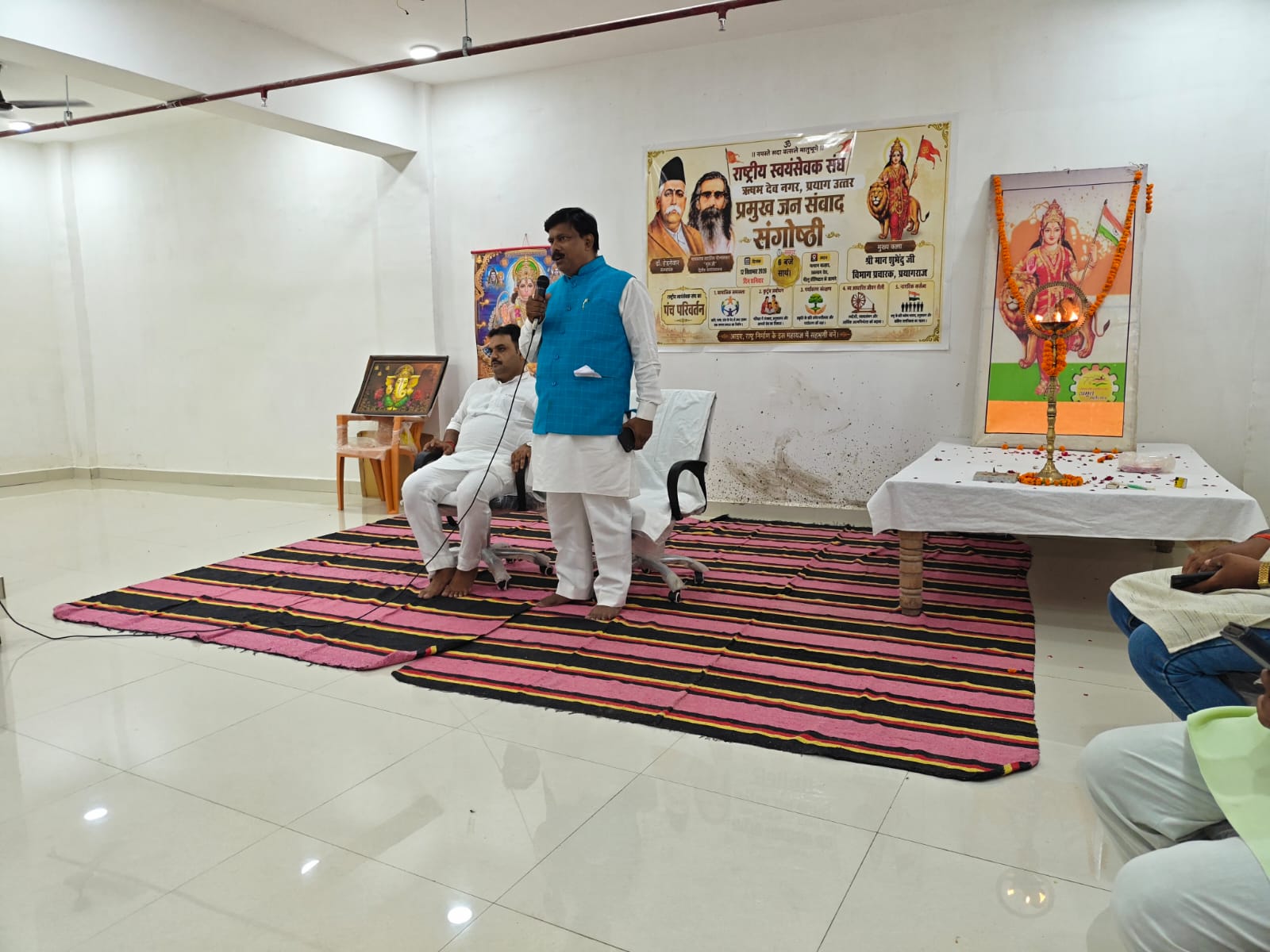
Discussions held on nation building, social harmony, Swadeshi and sanskars
Prayagraj: To commemorate the centenary of the Rashtriya Swayamsevak Sangh, a public seminar was organized at Paltan Mall in Jhunsi. People from various walks of life participated in the program and discussed topics such as nation-building, social harmony, environmental protection, Swadeshi, self-reliant India, and the preservation of Indian culture and traditions.
The program began with the lighting of lamps and the singing of the song Vande Mataram. Chief guest, respected Subhandh Subhendu Ji, Department Pracharak of the Rashtriya Swayamsevak Sangh, Prayagraj, said that since its inception, the Rashtriya Swayamsevak Sangh has been working tirelessly to strengthen service, values, discipline, and nationalism in society. The purpose of the Sangh’s centenary year is not merely to celebrate a year, but to connect every individual in society with national interest and social responsibility.
He said that national progress is possible only when every segment of society understands its responsibility and plays a positive role. Promoting the use of indigenous goods, he called for the adoption of local products. He said that encouraging local products and artisans will strengthen the resolve for a self-reliant India and will also play a significant role in making the last person in society self-reliant.
The seminar focused on family systems and values. Speakers emphasized the need to connect the younger generation with Indian culture, history, and family values. The spirit of the joint family needs to be strengthened, otherwise future generations will drift away from the depths of intimate relationships like those of uncles, paternal uncles, aunts, and maternal aunts. Along with imparting a cultured education to children, they should also be taught the stories of the country’s heroes and its glorious history to instill in them a sense of nationalism and social responsibility.
Speakers stated that serving the vulnerable, needy, and disadvantaged is every citizen’s responsibility. Emphasis was also placed on planting more trees to protect the environment and making water conservation a mass movement.
While presiding over the seminar, Rajnikanth, State Co-ordinator, NGO Cell said that it is a matter of great fortune and pride for all of us to have the holy company and guidance of our guardian and guide, Department Pracharak, respected Subhandh Subhendu ji.
He said, “Respected Shubhendu ji, the arrival of a saintly figure like you, an ascetic, cultured, and dedicated life to national service, on our campus is no less than a sacred occasion for us. Your powerful thoughts, simple personality, and dedication to the national interest have given us all new energy, inspiration, and direction. With your guidance, this campus will undoubtedly become a center for many resolutions of service, self-reliance, self-reliance, and social welfare in the times to come.”
Rajinikanth said that society should embrace indigenous products and take advantage of the government’s ODOP (One District One Product) scheme. By encouraging local products, artisans, and small entrepreneurs, society can play a vital role in building a self-reliant India. This will increase employment opportunities and will also be a meaningful step towards making the economically weak and the last person self-reliant.
On the occasion of the Sangh’s centenary year, those present at the seminar resolved to make service, values, social harmony, Swadeshi, and national interest the foundation of their lives. The program concluded with the national anthem.
On this occasion, senior officials of the Sangh including Rajnikanth, Dilip ji, Dr. Deepak, Rajesh Verma, Santosh Pandey, Pawan Srivastava, Amrish Kant, Kuriddhi, JP Singh Patel, social workers and a large number of dignitaries were present.
At the end of the seminar, the organizers expressed their heartfelt gratitude to all the guests and attendees. The program conveyed a message of strengthening civic responsibility towards the nation, society, culture, family, and environment.


