
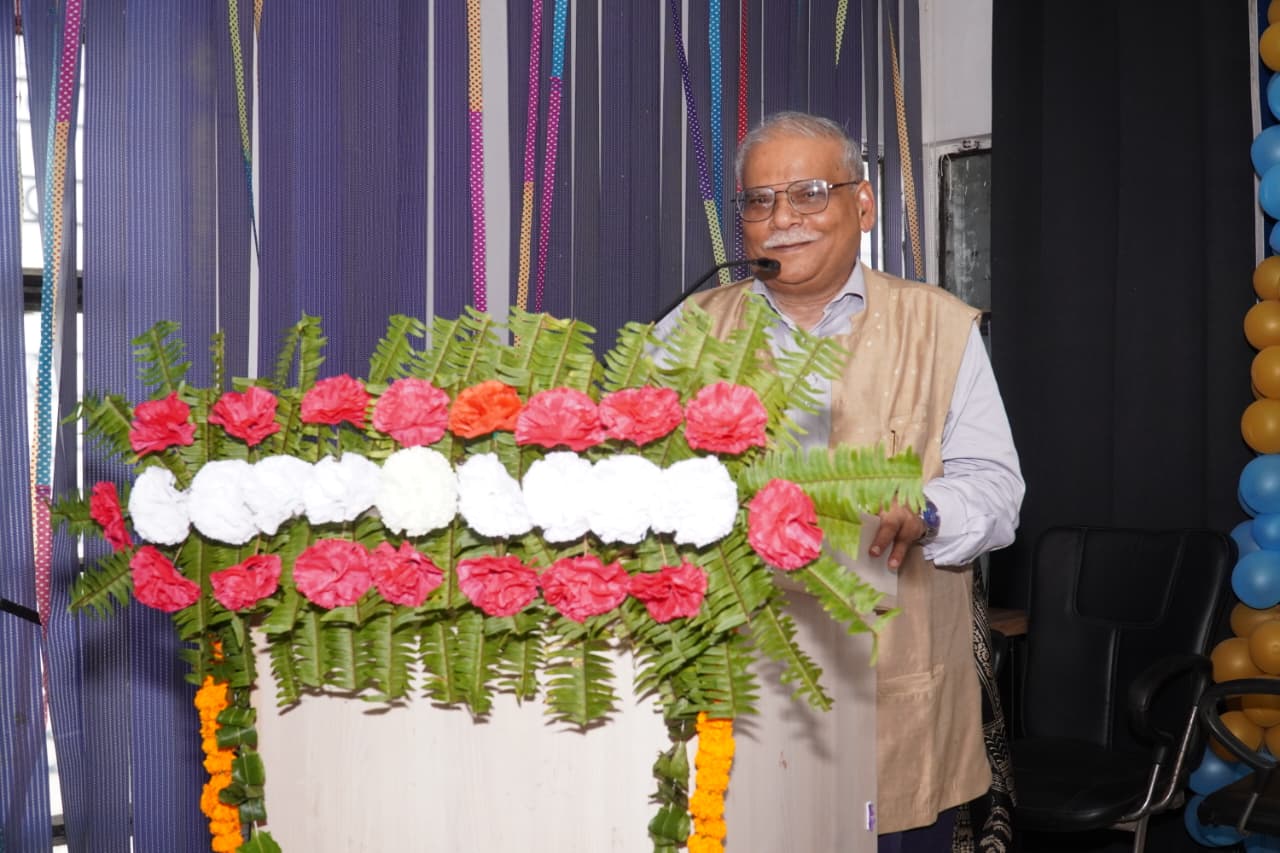
2-day seminar on AI for Rural Innovation, Digital Inclusion and Sustainable Development concludes at NGBU
Prayagraj: The two-day seminar organized by the Department of Computer Applications under AICTE-VAANI at Nehru Gram Bharati (NGBU) Deemed to be University, concluded on Sunday. The seminar was organised as an important academic initiative towards linking the resolve of Viksit Bharat@2047 with technological innovation, social inclusion and rural development. The theme of the conference, held at Arjun Singh Hall, Shashi Campus, was “Artificial Intelligence and Data Science for Rural Innovation, Digital Inclusion and Sustainable Development: Goal of Viksit Bharat 2047”.
The Chief Guest, Prof. Rajeev Tripathi from MNNIT, in his address, while sharing his views on the present form of Artificial Intelligence, its possibilities and its impact on human life, said that AI can never replace natural intelligence. He clarified that Artificial Intelligence should be understood not as a replacement for human intelligence, but as a technology that empowers human wisdom, creativity, sensitivity and decision-making ability. He said that the real significance of technology lies only when it is used to improve human life and to take development opportunities to the wider sections of society. In the conference, experts prominently underlined the idea that the goal of Viksit Bharat@2047 will be meaningful only when the benefits of digital and technological development are not limited to metropolitan cities but reach the villages and the last person of the society.
Presiding over the program, NGBU Vice-Chancellor Prof. B.B. Tiwari emphasized on linking the role of universities not only to the dissemination of knowledge but also to research, innovation and social responsibility. He said that higher education institutions should develop such an academic and research culture that contributes effectively to solving the real challenges of the country and society.
Pro Vice-Chancellor Dr. S.C. Tiwari, in his address, highlighted the contemporary relevance of the theme of the conference and emphasized the need for responsible, ethical and inclusive use of AI and Data Science. He said that technology is meaningful only when its benefits reach the last person.
The Registrar NGBU S.S. Mishra presented an introduction to the academic and institutional activities of the University. Dean Management & Computer Application Prof. Rajesh Kesari welcomed the guests and participants. Coordinator of the conference, Dr. Sandeep Anand, threw light on the theme, objectives and broad perspective of the conference, informed that three thousand institutions had applied for this conference on AICTE-VAANI but 200 across India and 4 institutions in UP were selected, including Nehru Gram Bharati University.
On the second day of the conference, 4 technical sessions were conducted.
In Technical Session-I, Prof. Shekhar Verma, Indian Institute of Information Technology (IIIT), Allahabad presented his lecture on the topic “Technical Foundations of AI and Data Science: Intelligent Systems.” In his lecture, he elaborated on the core principles of AI, data-driven architectures, and the evolution of intelligent systems in contemporary research and applications.
While, in technical session-II, Prof. Madhvendra Mishra, of IIIT, Allahabad spoke on the topic “Responsible AI in Organizations: Governance, Ethics, Data-Driven Decision-Making and Sustainable Adoption.” He emphasized the need for ethical frameworks, governance models, and sustainable strategies for the responsible deployment of AI in organizational and societal contexts. The seminar was inaugurated with lighting of the lamp and worship of Goddess Saraswati. The program was graced by the presence of Dr. Himanshu Tandon, Dr. Sharad Srivastava, Shri Ujjwal Das, Dr. Rajesh Kesarwani, Dr. K.K. Tiwari, Ritesh Singh, Jyotima Tiwari, Ramangi Pandey along with senior administrative and academic officers, teachers, researchers and participants of the University. The program was conducted by Dr. Monisha Gupta. Co-coordinator of the seminar, Dr. Arvind Kumar Shukla, proposed the vote of thanks.


