
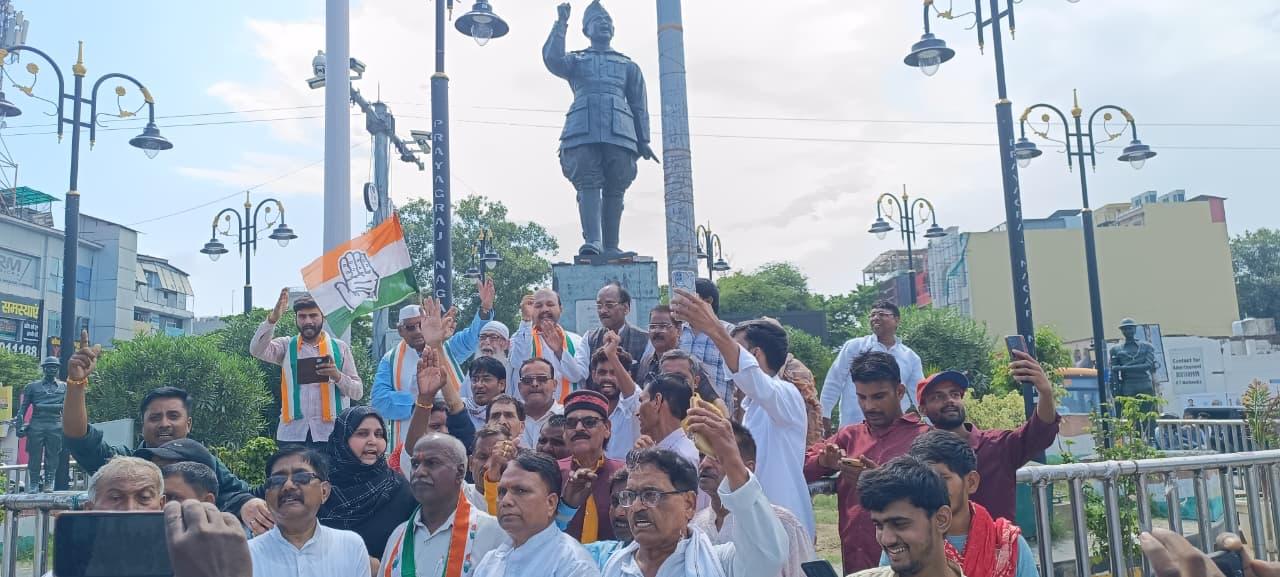
Prayagraj: Senior Congress leader, ex-AICC representative and member Grand Old Party’s UP political affairs committee, sat on dharna to express solidarity with protesting students. He also led a march voicing anger on in-human treatment being meted out to Leader of Opposition Rahul Gandhi and Waynad MP Priyanka Gandhi. He called off his dharna after Dharmendra Pradhan resignation and said, “The moral authority of the regime is gone. The polity is not willing to suffer tin-pot authoritarians in perpetuity. Above all, 2029 is no longer the done deal many had assumed it would be. Anyone who visited Jantar Mantar at the peak of the recent protest could not help noticing an atmosphere at once un-awed and unadulterated in its hostility towards Prime Minister Narendra Modi. One hour at that newly consecrated site of defiance and resistance was all it took to frame the obvious question: Why hasn’t Modi thrown Dharmendra Pradhan under the bus? Is an inconsequential politician so indispensable that the regime would risk its own survival in order to save him? Why was the time-tested device of sacrificing a pawn in order to save the King not been used?”
“By the time Pradhan was asked to pack his bags Saturday afternoon, it was already too late. The unmovable emperor proved to be no match for the unstoppable force that was India’s youth. And with this, the myth of Modi’s invincibility stands punctured. The buck stops at the Shahenshah, of course, but there is already chatter about how Amit Shah and other darbaris, including the RSS brass, contributed to this colossal and costly mishandling. How the scores eventually get settled is the internal business of the ruling establishment. But, for the larger polity the gains are unmistakable—and, irreversible. The entire episode has cast a spotlight, once again, on Prime Minister Narendra Modi’s self-inflicted isolation. He is a leader who is fond of soaking himself in the false and meretricious adulation of foreign lands, perhaps even seeing this as a way of getting away from the anxieties and resentments of the street at home. The “Cockroaches” at Jantar Mantar have ensured that Modi will no longer be accepted as master of the game,” he remarked.
“To begin with, Modi’s aura of invincibility was anchored in his claim to be the role of sole and supreme priest of Indian nationalism. He and he alone embodied ‘national interest.’ All his rivals, detractors or critics could be diminished with the tag of ‘anti-national’ or ‘anti-Indian’. The ‘cockroaches’ at Jantar Mantar knew the Modi playbook; they mocked and ridiculed the charge. Unlike Modi’s traditional rivals, the youth in Delhi and other cities and towns around India refused to be on the back-foot. Because their demands were linked to the education system, the regime’s apologists – otherwise quite skilled in tarnishing partisan or ‘ethnic’ movements – found it impossible to pigeonhole the cockroaches. Attempts by regime-friendly anchors to portray them as Pakistan, American or Chinese agents fell flat. Not just the prime minister but the entire Sangh parivar and its allied industry of disinformation will soon find that their ability to control and calibrate the national narrative stands vastly depleted,” he claimed.
“Second, a simple lesson from the past hundred years of Indian political history is that “charisma” lasts only as long as the “charismatic leader” is able to demonstrate an ability to deliver success and progress. The “cockroach revolution” is able to find traction in the national imagination precisely because the Modi regime has proved itself incapable of setting right a flawed ‘system.’ After more than a decade in power, no leader is entitled to pretend that they cannot be held accountable for ‘collapse’ of the ‘system’ in this or that sector, least of all something so basic as examinations. The Dharmendra Pradhan episode has exposed the fact that the prime minister’s credibility stands vastly depleted. His latest assertion of determination to “punish” the “guilty” was rightly juxtaposed with his previous –and, unfulfilled—promises to do exactly the same thing a few years back. Sooner or later, the sleight of hand is seen through. His eleventh-hour attempt to portray sincerity and trustworthiness through an Instagram reel was seen as nothing but the not-so-clever trick of a politician,” he asserted.
“Troublesome images of “security forces” gone berserk against young boys and girls will not fade away soon and will continue to gnaw at the conscience of the middle classes still in Modi’s corner. No less disquieting for each and every citizen were the images of the Leader of Opposition – being roughed up by policemen. This is just not done. Photographs of a bleeding Rahul Gandhi will keep nibbling away at our collective sense of fair play. Since it is not known who, if anyone, is quarterbacking the “Cockroaches”, no one knows how the Jantar Mantar passion and fervour will be channelized or repurposed. The BJP is hoping this energy dissipates. What is certain, however, is that the mythology of a perfect control and command regime can no longer be sustained. The moral authority of the regime is gone. The polity is not willing to suffer tin-pot authoritarians in perpetuity. Above all, 2029 is no longer the done deal many had assumed it would be,” he opined prior to signing off.
Taslimuddin, Om Prakash Tiwari, Raghunath Dwivedi, Mukund Tiwari, Chandranath Chaudhary, Anupam Dwivedi, Nayan Kushwaha, Rakesh, Supriya, Mrityunjay, Madhuri Rai, Ratna Pandey, Seema Tripathi, Avinash Verma Advocate, Pradeep Kumar Dwivedi and hundreds others staged demonstration and participated in protest march led by Shekhar Bahuguna.


